
Beyond Visual Inspection: Flatness and Roughness for Rolling, Coating, and Finishing Lines
Real Time Monitoring
Do you really want to know how your strip is flat?
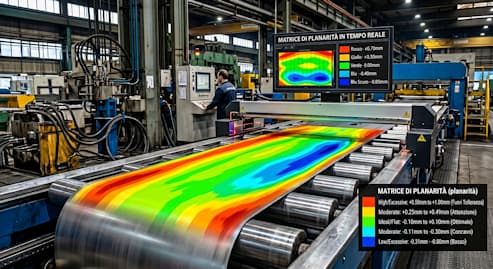
| Inline Inspection
Online Flatness & Planarity
From macroscopic imaging of flatness, wide range depressions, local depressions up to to the micrometric grain size

| Inline Inspection
Shape Factor Analysis
Multiple flatness indices: I-units, steepness, center wave, edge wave
Real-time Display
3D shape visualization and trend monitoring
Closed-loop Control
Direct integration with mill actuators for automatic flatness correction
Defect Classification
Automatic detection of quarter buckle, center wave, edge wave
How Flatness Measurement Works
Advanced laser-based stress measurement technology
Distance Measurement
Multiple laser sensors measure the distance to the strip surface across the entire width at high frequency
Profile Reconstruction
Advanced algorithms reconstruct the full 3D shape profile of the moving strip in real-time
Stress Calculation
Convert shape deviation into internal stress distribution (I-units or % elongation)
Actuator Feedback
Send correction signals to roll bending, shifting, or cooling systems for automatic flatness control
Industry Applications
Critical flatness control for demanding applications
Hot Rolling Mills
Flatness control for hot rolled strip and plate for steel and aluminum
Cold Rolling Mills
Precision flatness measurement for tinplate, automotive, and appliance grades
Aluminum Rolling
Flatness control for aluminum sheet, foil, and aerospace alloys
Tension Leveling Lines
Post-processing flatness verification and shape correction
Cut-to-Length Lines
Flatness inspection for precision blanks and sheets
Slitting Lines
Edge wave and crossbow detection for slit coils
Integrated Automatic Flatness Control
(AFC)
From measurement to correction in milliseconds
Measure flatness across full width
Calculate shape error profile
Compute actuator correction
Send to mill actuators
Verify correction
Resources & Documentation
MisPlana Flatness Measurement System - Datasheet
Complete technical specifications including measurement range, accuracy, sensor configurations, and installation drawings for all flatness gauge models.
AFC Integration Guide
Detailed documentation for integrating LGE flatness measurement with mill actuators including work roll bending, roll shifting, and zone cooling systems. Includes control algorithms and PLC integration examples.
Flatness Control Success Stories
Read how leading steel mills improved flatness quality by 65% and reduced rejects using LGE flatness measurement with automatic flatness control. Case studies include hot strip mills, cold mills, and aluminum rolling lines.